The Best Time to Visit Antarctica: Routes and Seasons
Evorand · 2 October 2026
Antarctica changes throughout its short travel season. A considered guide to matching wildlife, ice conditions and expedition formats with the journey you want.
The best time to visit Antarctica is generally November to March: choose November for snow-covered scenery, December and January for long daylight and penguin breeding activity, or February and March for whale watching. Most first-time visitors explore the Antarctic Peninsula, either sailing from Ushuaia or flying from Punta Arenas to join an expedition ship.
What determines the best time to visit Antarctica?
Your preferred wildlife encounters and tolerance for changing ice conditions matter more than finding one universally perfect month. Antarctica's short visitor season contains several distinct experiences, rather than a single summer repeated across different departure dates.
The seasonal pattern is useful, but not a timetable for nature. Penguin breeding varies by species and colony, while wind can move sea ice and alter access quickly. Choose a period that supports your interests, then allow the expedition team to interpret conditions on the ground.
November: snow and the beginning of the breeding season
November often brings extensively snow-covered shores and penguins returning to the business of courtship, nesting and egg-laying. For photographers, the attraction is as much the landscape as the wildlife: clean snowfields, sculpted ice and colonies set against a wintry backdrop.
More sea ice can also mean fewer navigable passages or accessible landing sites. An early-season journey suits travellers who appreciate that an alternative bay may be more rewarding than insisting on a named destination.
December and January: long days and penguin colonies
December and January combine extensive daylight with active penguin colonies; chicks become visible at different times according to species and location. These months offer a compelling balance for a first expedition, without guaranteeing any particular stage of the breeding cycle.
Long daylight gives expedition teams a broad operating window, not unlimited activity. Landings still depend on wind, swell and environmental restrictions. Holiday-period travel also makes adjoining cabins and complex family flight arrangements worth addressing early.
February and March: whales and a changing coastline
February and March are often favoured for whale watching around the Antarctic Peninsula, including encounters with feeding humpbacks. Sightings remain unpredictable, and responsible observation means allowing the animals to determine their movements.
Many shores become less snow-covered as summer progresses, while penguin colonies change with chick development and moulting. Retreating sea ice may improve access farther south, but crossing the Antarctic Circle remains conditional. Shortening days also bring a different photographic rhythm.
Should you sail the Drake Passage or fly?
Sailing offers a continuous ocean expedition, while a fly-cruise reduces time crossing the Drake Passage at the cost of greater dependence on Antarctic flying conditions. Neither format removes weather-related uncertainty.
Ships departing Ushuaia usually take around two days to cross the Drake Passage, depending on the vessel and sea conditions. The crossing provides time for seabird watching, polar lectures and the gradual transition into Antarctic waters. It can also be rough, and no departure month guarantees calm seas.
Fly-cruise programmes typically operate between Punta Arenas and King George Island, with flights taking roughly two hours. Low cloud, visibility and wind can delay operations. Check whether the programme flies both ways or combines a flight with a sailing, and understand the contingency arrangements before booking.
Which Antarctic route should a first-time visitor choose?
The Antarctic Peninsula and South Shetland Islands provide the most straightforward introduction to expedition travel in Antarctica. Their sheltered bays, glacier fronts and penguin colonies offer variety without requiring a much longer subantarctic itinerary.
Compare days in the expedition area rather than simply nights aboard. Two voyages of similar length can allocate very different amounts of time to ocean crossings and exploration. If setting foot on the Antarctic mainland matters, distinguish mainland landings from visits to offshore islands; neither should be treated as guaranteed.
Adding the Falkland Islands and South Georgia creates a different journey, with more open-ocean sailing and a broader wildlife focus. South Georgia's king penguin colonies are a reason to travel in their own right, not a minor extension to a Peninsula voyage. Allow substantially more time rather than compressing the Antarctic portion.
What does a private expedition actually change?
A private expedition can offer greater control over the group's pace and interests, but it does not override weather, wildlife protection or landing permissions. Privacy should never be confused with unrestricted access.
Look beyond the accommodation to the expedition operation: Zodiac capacity, guide expertise, medical provision and arrangements for getting ashore. A smaller travelling party may simplify coordination, but safe access still depends on local conditions. Discuss mobility requirements before selecting a vessel.
Helicopters, where carried, add another possible perspective rather than a promise of daily flights or unrestricted landings. Operations depend on weather, authorisations, safety assessments and environmental requirements. Establish which activities are included, which need separate approval and what happens when conditions prevent them.
How should you organise flights and contingency time?
Build the journey around protected connection time, not the shortest possible itinerary from home to ship. The expedition's departure point is only one stage in a chain of international flights, regional connections and transfers.
Ushuaia itineraries commonly connect through Buenos Aires; Punta Arenas itineraries commonly connect through Santiago. Check airport changes, baggage arrangements and whether separate tickets leave you responsible for a missed onward flight. Arriving on the day the vessel departs creates unnecessary exposure to disruption.
- Confirm the embarkation briefing and required arrival arrangements before booking flights.
- Separate days exploring Antarctica from days travelling to and from the gateway.
- Leave room for disruption at both ends, particularly with Antarctic flights.
- Read the operator's delay, cancellation and alternative-routing provisions.
- Verify insurance for the itinerary, planned activities and medical evacuation.
What should you expect during a landing?
An Antarctic landing is a supervised wildlife and landscape visit, with boundaries set by the expedition team and environmental rules. It is not an independent shore excursion.
Zodiac transfers may involve stepping into shallow water, uneven footing and exposure to wind. Waterproof outer layers, suitable boots and spare gloves matter more than a large wardrobe. Ask what equipment the operator supplies before packing.
Biosecurity procedures include cleaning footwear and equipment to avoid moving seeds, soil or other biological material between sites. Wildlife health concerns, including avian influenza, can close locations or change activities. A Zodiac cruise may replace a landing even when the weather appears favourable.
How do you turn these choices into the right journey?
The strongest Antarctic itinerary begins with a clear hierarchy of interests, then matches season, route and vessel to those priorities. Decide whether snow landscapes, whales, penguins, photography or an extended ocean journey comes first.
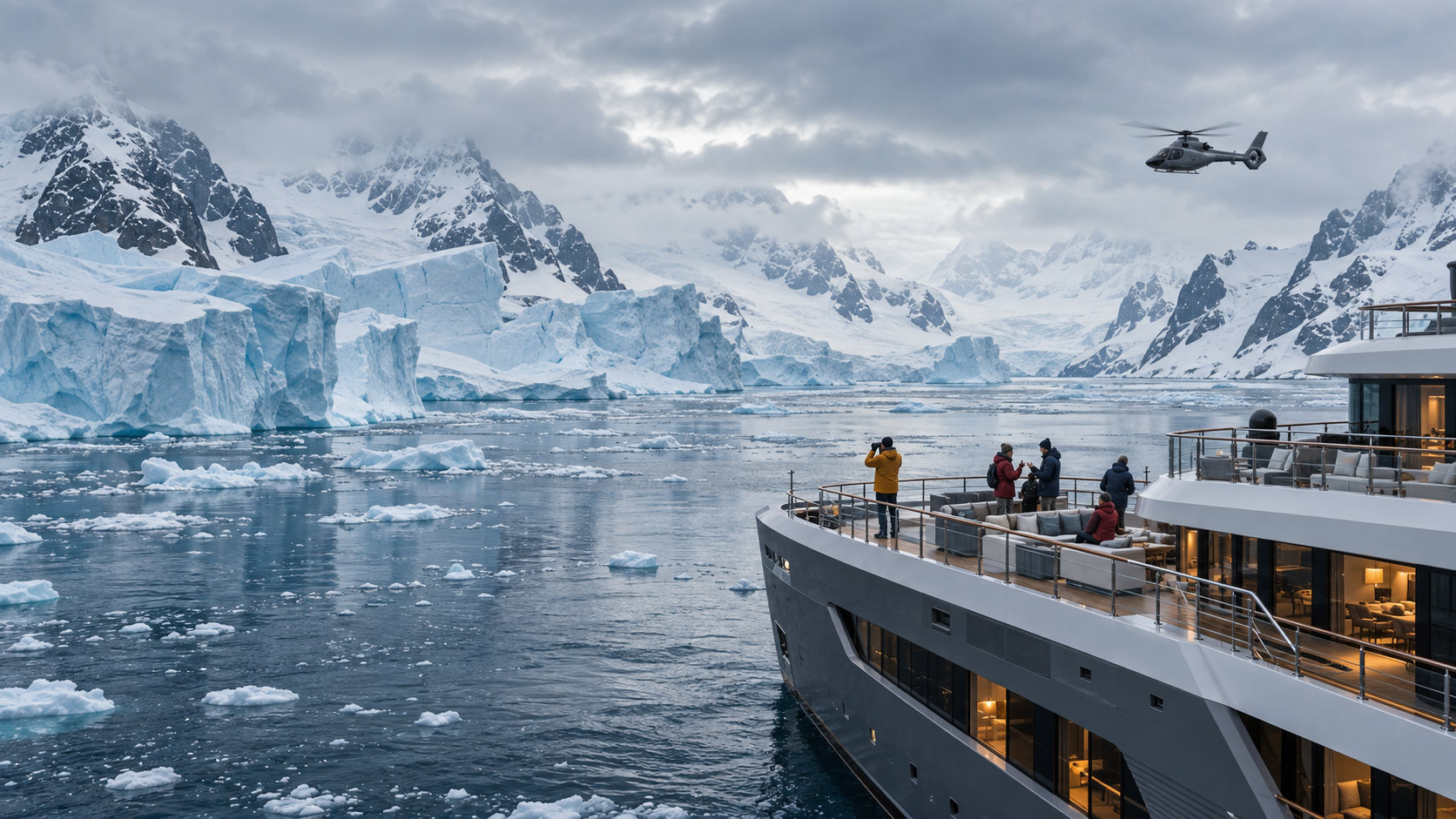
Evorand's Antarctica journey is presented around a private expedition vessel, helicopters and experienced polar specialists. When considering that format, operational flexibility, time for observation and the group's preferred pace deserve as much attention as the onboard setting.
To explore an Antarctica journey with Evorand, share your preferred travel window and what you most want to experience. Those details provide the starting point for a considered route and season.
Frequently asked questions
- Do you need a visa to visit Antarctica?
- Antarctica has no national tourist visa system, but expeditions are subject to permissions and notifications under relevant national regulations. Travellers must separately meet entry and transit requirements for gateway countries such as Argentina and Chile.
- Can children join an Antarctic expedition?
- Minimum ages and participation requirements vary by operator and vessel. Suitability also depends on a child's comfort at sea, ability to follow wildlife instructions and capacity to manage Zodiac transfers safely.
- Will a Peninsula cruise visit emperor penguin colonies?
- Standard Antarctic Peninsula itineraries are not designed around emperor penguin colonies. Dedicated emperor penguin journeys require different locations, specialist logistics and suitable seasonal conditions.
- Is reliable internet available on Antarctic ships?
- Some expedition vessels offer satellite internet, but speed and availability vary with the ship, service and location. Do not assume uninterrupted video calls or continuous access for remote work.
- Can visitors fly a personal drone in Antarctica?
- Drone operations are subject to environmental authorisations, site restrictions and operator policies, and many tourist expeditions prohibit personal use. Obtain written guidance from the operator before bringing equipment.