Raja Ampat Private Yacht Charter: Getting There and Going Well
Evorand · 13 October 2026
A considered Raja Ampat voyage begins before boarding: with the right flight connections, a realistic cruising radius and enough time to linger. Here is how to bring those decisions together.
A Raja Ampat private yacht charter typically begins with a domestic flight to Sorong, Indonesia, followed by a road and boat transfer to the yacht’s agreed embarkation point. Confirm the yacht’s location and cruising plan before booking flights: the best connections depend on where you board, which islands matter most and how long you have aboard.
Raja Ampat rewards a different kind of itinerary discipline. Rather than collecting distant landmarks, choose a coherent area and leave room for currents, weather and the occasional bay worth another afternoon. The journey becomes considerably more satisfying when time in transit is treated as carefully as time underwater.
How do you reach Raja Ampat from overseas?
Sorong’s Domine Eduard Osok Airport, identified by the code SOQ, is the principal air gateway for sea journeys into Raja Ampat. Sorong lies in Southwest Papua, in eastern Indonesia; most international visitors connect through an Indonesian domestic hub.
Jakarta’s Soekarno–Hatta Airport, code CGK, is a practical starting point when comparing international arrivals and onward services. Other connections depend on the operating schedules for your travel period. Do not assume that a stay in Bali will connect directly to Sorong without another stop.
Check whether flights are on one protected booking or separate tickets. Separate arrangements may require baggage collection, another check-in and enough time to absorb a delayed international arrival. An overnight stop in Jakarta or Sorong can be a sensible investment in rest rather than an unnecessary interruption.
Do you need the ferry from Sorong to Waisai?
You need the Waisai ferry only if the agreed itinerary requires you to travel independently to Waigeo before joining the yacht. A charter embarking in Sorong may instead involve an airport pickup, a road transfer and a short tender ride.
Waisai, on Waigeo Island, is an important regional transport centre. Fast-ferry journeys from Sorong commonly take around two hours, but departures and crossing times must be checked against current schedules and sea conditions. Ferry tickets should not be purchased until the yacht’s boarding arrangements are confirmed.
Ask for the complete arrival sequence, including who handles luggage, where you wait if the yacht is not ready and what happens after a delayed flight. Guests with limited mobility should establish whether boarding involves steps, an exposed jetty or a moving tender. “Airport transfer included” does not explain those details.
When is the best season to charter?
October through April is a widely favoured period for Raja Ampat yacht and diving itineraries, although conditions vary across the archipelago. Tropical rain remains possible, and favourable seasonal patterns do not guarantee calm water on every crossing.
Southern routes around Misool deserve particular scrutiny during windier parts of the year. Conditions in central or northern Raja Ampat may differ, so match travel dates to a proposed cruising area rather than treating the entire region as one weather system.
Dive planning also follows tides and currents. A particular reef may be best visited at a different hour from the one suggested by a fixed daily schedule. Manta encounters and other wildlife sightings remain possibilities, never contractual promises.
How long should a Raja Ampat private yacht charter be?
Around a week aboard is a useful planning starting point for a focused first visit, rather than a minimum required by every yacht. Concentrating on one area allows a balance of exploration, unhurried meals and time to settle after long-haul travel.
For a voyage combining central Raja Ampat with Misool, consider a broader planning window of roughly ten to fourteen nights. These are itinerary suggestions, not fixed passage requirements: vessel speed, weather and embarkation location can change what is realistic.
Longer crossings may take place overnight, which saves daylight but can affect sleep through movement and engine noise. Ask which passages are expected and where cabins sit relative to machinery. Your total holiday allowance must also include international travel, connection buffers and the interval between the final dive and flying.
Which islands belong on your route?
The most useful route distinction is between a central-islands voyage and a wider expedition towards Misool or Wayag. Plotting all three on a map is easy; connecting them without sacrificing most of the leisure time requires a more generous schedule.
Is the Dampier Strait best for a first visit?
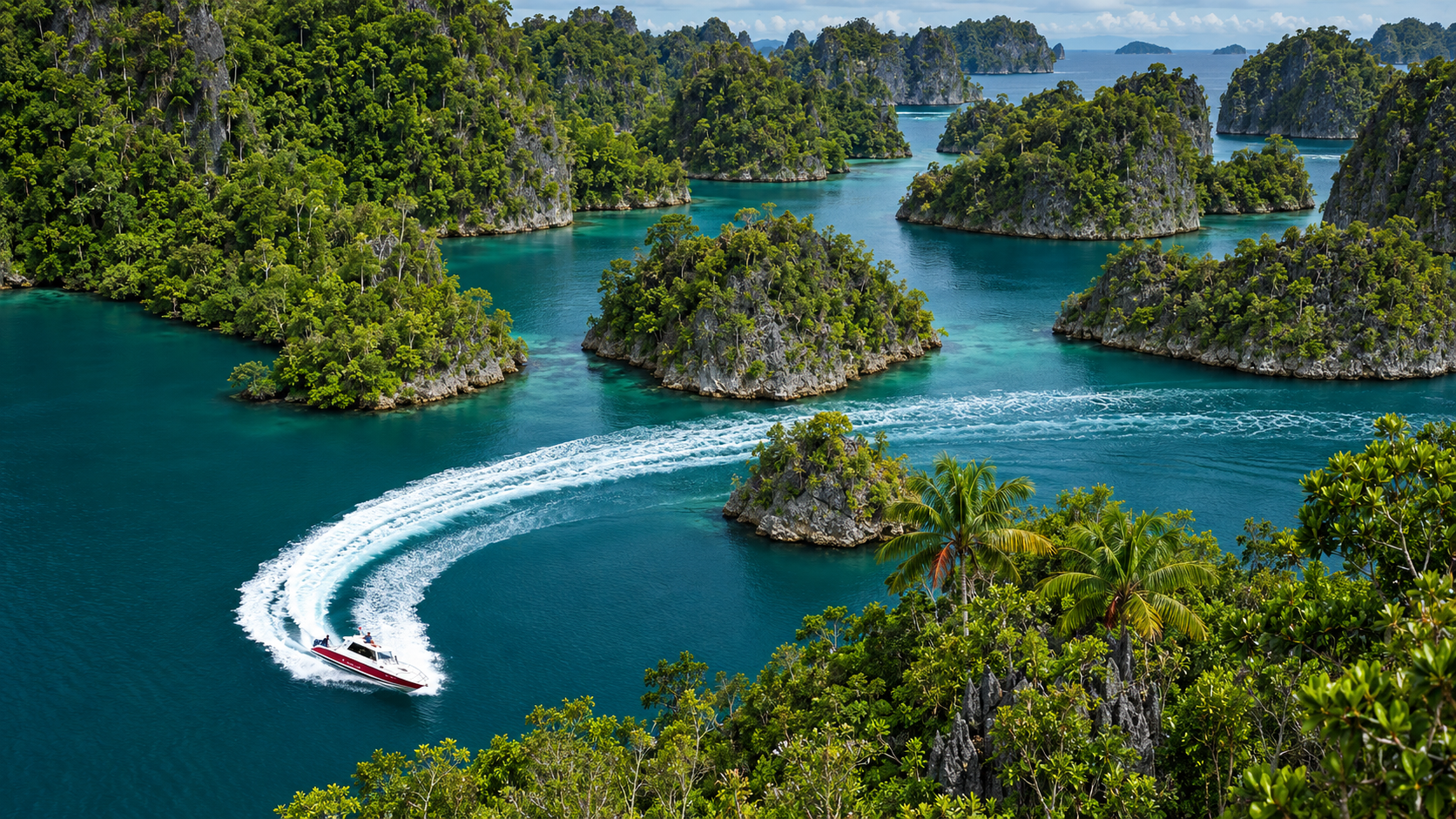
The central area around Waigeo, Gam and Mansuar offers a strong mix of reefs, island scenery and village visits. Piaynemo’s limestone-island viewpoint can complement time on the water when conditions and visitor arrangements allow. Its steps and tropical heat should be considered when assessing suitability for the group.
Should you choose Misool or Wayag?
Misool lies to the south and suits a voyage built around its lagoons and reef landscapes. Wayag lies to the north and requires a different routing commitment. Wayag and Piaynemo are distinct places, despite sometimes appearing interchangeable in collections of Raja Ampat photographs.
Choose two or three essential experiences before asking for a day-by-day schedule. A longer snorkelling session, a particular landscape or fewer open-water passages provides more useful direction than an extensive list of island names.
Does everyone aboard need to dive?
A private yacht can work well for a mixed group of divers and non-divers when staffing, tenders and daily activities support both. Do not assume a vessel designed around intensive diving automatically offers an equally considered programme above water.
Ask whether non-divers can take a guided snorkelling excursion while the dive group is elsewhere. Kayaking, where offered and permitted, shore visits and photography can create a separate rhythm. Strong surface currents mean that not every celebrated dive site is suitable for casual snorkelling.
Divers should disclose certification, recent experience and comfort in currents before the itinerary is finalised. For repetitive no-decompression diving, widely used guidance recommends at least eighteen hours before flying; allowing twenty-four hours or more creates a more conservative scheduling margin. Follow the requirements appropriate to your actual dive profile, computer and qualified dive team.
What does private access actually mean?
A private charter reserves the yacht for your party, not the surrounding islands, reefs or marine protected areas. Local permissions, conservation requirements and community expectations still govern where and how visits take place.
The value of local knowledge is in responsible timing and interpretation, not in bypassing restrictions. A village visit should be agreed appropriately, and a quiet anchorage cannot be promised as permanently empty. Weather and safety decisions must remain with the captain.
Before committing, request a written explanation of the operational essentials:
- Routing: Embarkation and disembarkation points, expected passages, fuel terms and any repositioning arrangements.
- Diving: Guide provision, equipment, compressor facilities and nitrox availability if required.
- Safety: Emergency oxygen, communications, evacuation planning and suitable insurance for remote-area activities.
- Comfort: Cabin layout, air-conditioning arrangements, shaded deck space and tender boarding.
- Inclusions: Transfers, conservation charges, shore visits, drinks and the approach to crew gratuities.
Confirm connectivity on the specific vessel rather than assuming reliable internet throughout the route. Dietary needs should be discussed early because provisioning options become limited once underway. A traditional wooden phinisi and a modern motor yacht may also offer very different cruising speeds and onboard sound levels.
What should you decide before making an enquiry?
The most useful initial brief gives a travel window, party size, preferred time aboard and a clear balance between diving, islands and rest. Add children’s ages, mobility requirements and any reservations about overnight passages.
Establish yacht availability and the broad logistical plan before purchasing flights. This keeps the voyage coherent, rather than forcing the crew to reconcile independently booked arrangements.
To explore Evorand’s Raja Ampat — The Last Paradise journey, share your dates and the experiences that matter most. The conversation can begin with the right stretch of water, and the time to enjoy it.
Frequently asked questions
- Do I need a separate visa for Raja Ampat?
- Raja Ampat is part of Indonesia and does not have a separate national visa system. Indonesian entry requirements depend on nationality, passport and length of stay; local visitor permits or conservation charges are separate matters.
- Can I fly a drone in Raja Ampat?
- Drone flights are subject to Indonesian aviation rules and any applicable local or protected-area permissions. Confirm approval for each intended location before flying; a private yacht booking does not grant aerial access.
- Is a Raja Ampat yacht voyage suitable for children?
- Suitability depends on the vessel’s age policy, safety equipment, boarding arrangements and the children’s swimming ability. Confirm child-sized life jackets and supervision expectations before booking.
- Should I carry cash in Raja Ampat?
- Card payments and ATM access can be limited on remote islands. Carrying Indonesian rupiah for agreed local expenses is useful, with the amount guided by what the charter already includes.
- What luggage works best on a Raja Ampat yacht?
- Soft-sided bags are often easier to store aboard than rigid cases, but confirm the vessel’s storage arrangements. Domestic airline baggage allowances should be checked separately, particularly when travelling with dive equipment.